
Endogamy: For generations, people in this community mostly married others from the same small group.
Pedigree collapse: Because of that, the same ancestor can show up more than once in your family tree — you’re related to them in more than one way.
In short: endogamy is the cause; pedigree collapse is the effect.
DELAWARE: Handsor-Wright-Sammons
MARYLAND-PENNSYLVANIA/OHIO: Prisby-Proctor-Patterson
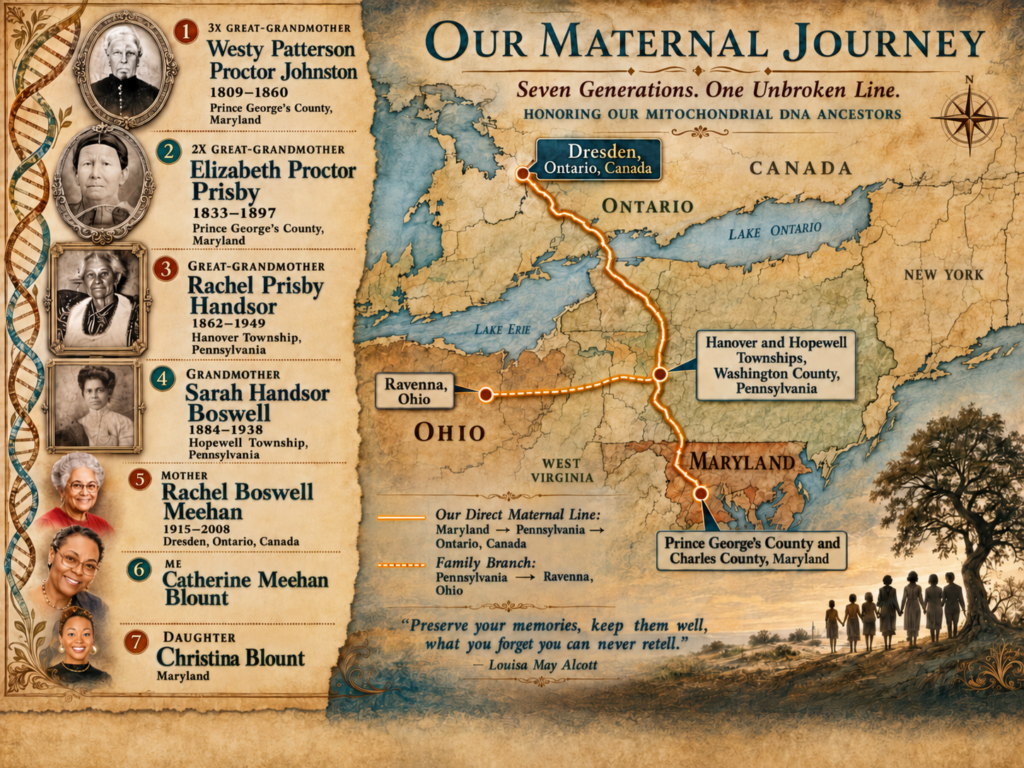
NORTH CAROLINA: Boswell-Richardson-Lynch-Bass
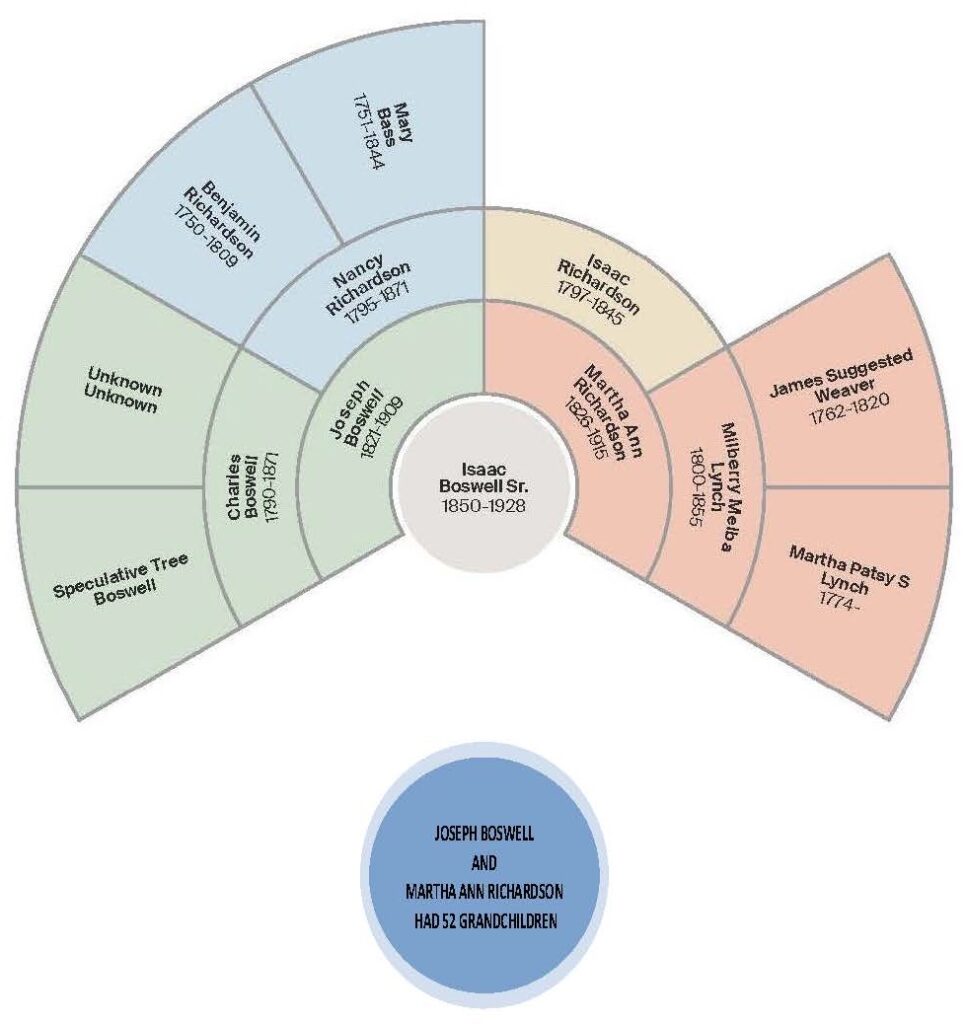
My maternal North Carolina lines descend from the Boswell, Richardson, Lynch, and Bass families. The fan tree at the right centers Isaac Boswell, Sr. (1850-1928), the oldest child of Joseph Boswell and Martha Richardson. The chart reflects the ancestry of Isaac and his siblings.
Isaac’s siblings and all of their known children are shown on the chart below.
A NOTE TO BE PLACED SOMEWHERE
Researchers should be cautious about birthplace claims in records supplied by the subject — particularly for people who migrated across borders, where naming a recognizable city rather than an unknown small town was a common and practical choice.
WRITTEN OUT OF THE RECORD
The Lost and Unnamed Fathers of the Proctor, Boswell, and Handsor Lines
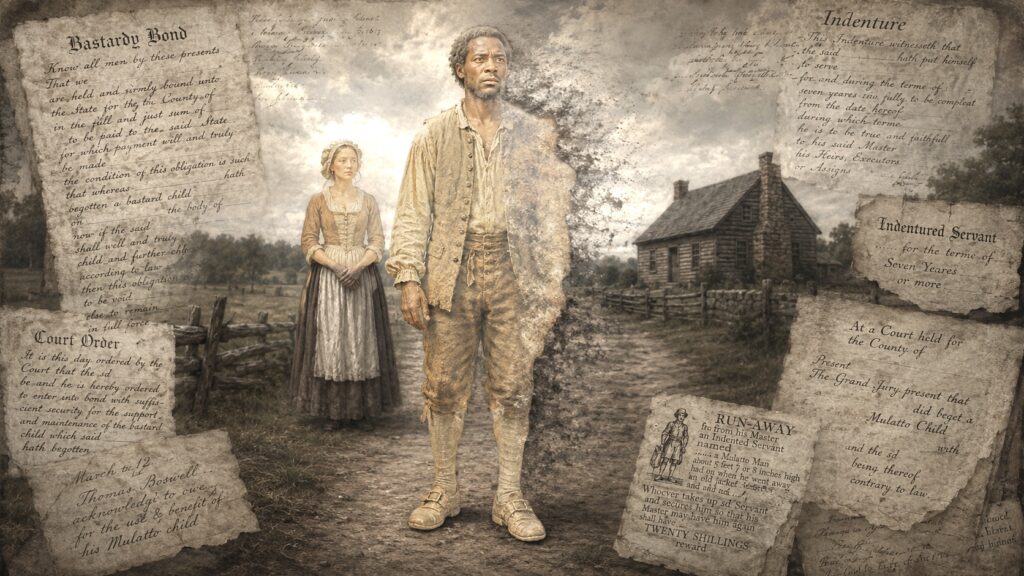
In 1662, the Virginia colony passed a law that would shape Black family history for centuries: a child’s status — free or enslaved — would follow the condition of the mother, not the father. This principle, partus sequitur ventrem, reversed English common law, which had always followed the father. For enslavers, the law was useful: it guaranteed that children born to enslaved women stayed enslaved, no matter who fathered them — including, often, the enslaver himself.
But the law had a second, quieter effect. It gave the court no reason to ever write a Black father’s name down. He held no legal claim to the child, no responsibility for the child’s status, and in most cases no standing even to be sued or questioned. Where the mother was white, the court’s business was with her alone — her fine, her years of added service, her confession. The father simply wasn’t the court’s concern.
That silence runs through all three families below.
Proctor
A 1705 Elizabeth Proctor was presented for “having a Mollatto bastard.” The father is not named. In 1707/8 she is presented again for “having a Mollatto child,” and again, the father is not named. It is Elizabeth’s story and name that carry forward. The Journal of Afro-American Historical & Genealogical Society recently published Reconstructing the Early Proctor Lineage, an article by Proctor descendant, Dr. Bonita Berryman Gilliam.
Boswell
In 1791, Dorothy Boswell, of a Boswell family with ties to Ware Neck, Gloucester County, Virginia, was disowned/removed by her Quaker monthly meeting for bearing a child out of wedlock. Charles Boswell, who serves as the nominal “beginning” of my Boswell family, appears in an 1818 marriage record as fully grown. I have been reconstructing his origins using DNA and historical records. Two separate direct-line Boswell males share an African YDNA haplogroup. If Charles’s father was of African descent, then my numerous white Boswell enslaver family descendants with whom I share DNA are from Charles’s maternal line. The only Boswell woman I have located who lived in an area where Charles could have been and who bore a child whose birth year closely matches Charles’s was Dorothy Boswell. The evidence is not conclusive, but suggests that a third line from my maternal family traces through a white woman.
Handsor
A 1665 record detailing a support agreement between Richard Johnson and Thomas Tunnell for Mary Vincent’s child names her as Aminadab’s mother. His alleged father is also Aminadab, Slave of Southy Littleton, of Accomack County. We do learn that Southy Littleton gave the younger Aminadab, “sonne of my servant Aminadab negro deceased and Mary Vincent Three cows and there female increase wch were formerly given to my said servant.” From there, the Handsor story continues through Mary Vincent, who married John Oakey.
None of this was an accident of unmarried parents or incomplete recordkeeping. It was how the system was built to work. The law that erased these fathers from the record is long gone, but the pattern it left behind — present mothers, absent fathers — outlived it, hardening over time into assumption, and the assumption into a stereotype that still follows Black families today. Aminadab, Elizabeth Proctor’s unnamed partner, and Charles Boswell’s father were not absent men. They were, by design, unrecorded ones.
We were – truly – “Made in America.”
WHERE DID THE DNA GO?
A comment about the often-heard phrase, “Every Black Person Thinks They Have Native Ancestry.”
It’s a line you’ll hear at conferences, in Facebook groups, sometimes from genealogists whose work you otherwise respect, often delivered with a laugh, as though the belief itself is the embarrassment. It isn’t. The chart below shows why a real, documented ancestor can vanish from a DNA test within six or seven generations, through ordinary math, no error required. But math alone doesn’t answer the harder question: why did so many families arrive at the same story in the first place?
Some of that lore is inaccurate. It is absorbed from a neighbor’s tale, or misremembering a relationship that was real but different than described. That happens in every family, of every background. But some of it is accurate, carried forward the only way it could survive: in faces, not paper. A grandmother’s long black hair and high cheekbones, remarked on across three generations, are not “nothing.” For families who were denied the right to record their own ancestry, whose relationships were deliberately obscured under a racial classification system built to simplify and erase, a remembered face may be the only archive that survived. Dismissing that as wishful thinking treats the absence of paper as proof, when it is often simply the point of the erasure working as designed.
The honest position sits between credulity and ridicule. A described ancestor deserves the same treatment as a documented one: pursued through records where they exist, tested against DNA where it’s available, and reported with the same tiers used elsewhere on this site: documented, family account, or probable based on evidence. Sometimes that pursuit confirms the lore. Sometimes it reveals a different, equally real story underneath it, a relationship a generation or two off, or a connection through a line no one had thought to look at. And sometimes the DNA genuinely isn’t there, in you or in your line, even when it once was in the family. None of those outcomes make the person who carried the story foolish for having believed it. It makes them the last keeper of a record their family was never allowed to write down.
Whatever the story behind it, the chart below shows the same underlying truth: even a fully documented ancestor, with no lore attached at all, can disappear from a DNA test simply because of how inheritance works.
NOTE FOR CB (do not publish): Fifth explanation: Misclassified or unassigned. Because Indigenous American and East Asian populations share a deep common ancestral migration, and because reference databases for Indigenous American populations remain comparatively thin, commercial DNA tests have historically grouped these two categories together or struggled to confidently distinguish them at low percentages. Some companies have since split the categories apart — but a small, real signal from an Indigenous ancestor may still be reported as “unassigned” or folded into a broader regional category, rather than lost from the DNA outright. The ancestor’s contribution is there; the test’s confidence in labeling it correctly is what’s limited.
NOTE: See the Meehan DNA page for those families. (Add a link.)