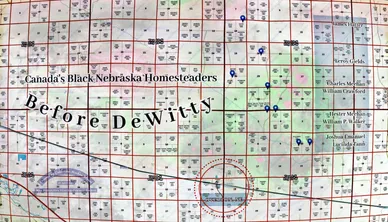
The Old Home Soil
Overton, Nebraska, has never been a large town. The 2020 US Census reflects a population of 561 people, a 58% increase over the 326 people recorded in Overton when the 1880 census was taken. Located in Covington Township, Overton has maintained a steady, if slow, population growth. I imagine Overton to be a place boasting a friendly, small-town character held in the face of a rapidly changing world.
But there is one glaring change between the 1880 and 2020 census reports. Unlike the total population of Overton, the racial demographics changed drastically. In 1880, 14% of Overton’s population identified as Black or Mulatto. By 2020, Overton is entirely devoid of people of African descent.
When black families began to return to the United States from Canada, many settled in the neighboring states of Michigan and Ohio. However, a small band of families from Buxton (Elgin Settlement), Ontario, set their sights on Nebraska. This group eventually formed DeWitty, NE, but first settled in Overton. The former Canadian black sojourners who appear in Overton’s 1880 census include families like Joshua Emanuel, William Walker, Isaac Riley, William Rann, William Small, and the Gields/Robinson family. The Robert Allen family from Kentucky rounded out Overton’s 45 black residents.
Unlike DeWitty, Nebraska, or Nicodemus, Kansas, the black settlers in Dawson County did not establish a separate community. They lived for almost thirty years as a community within a community. A 1969 Nebraskaland Magazine article by Jean Williams discussed attempts by black homesteaders to establish themselves in Nebraska. Many failed, but ‘by the turn of the century, one colony of Negroes was succeeding. These people filed claims on land near Overton in Dawson County in 1880. The homesteaders forming the nucleus of this settlement came from Canada. They were educated, weather-oriented, and skilled artisans, bringing goods, supplies, and money to sustain them until they could harvest a crop.’
In just a handful of years after the first black Canadian homesteader left Overton for Cherry County beginning in 1902, most of the black families from Canada followed. By 1915, the United States Postal Service established a post office in DeWitty, which went on to be referred to as ‘Nebraska’s largest and most permanent colony of African American homesteaders.’
In DeWitty’s shadow, the memory of the unnamed Overton colony of black settlers faded. But for the original Canadian group, Overton was home and the birthplace of the first generation of Canadian sojourners who returned to the United States.
Rose Meehan Speese wrote to her brother, Bill, in August 1946 after traveling back to Overton from Pierre, South Dakota. She spoke joyfully about seeing her childhood friends and concluded the letter by saying, ‘It sure felt good to step onto old home soil.’
If you’re interested in exploring more about the community or perhaps searching for a house for sale in Overton, NE, there are opportunities to discover the charm of this small town.
************
SOURCES
1880 and 1920 United States Federal Census, Ancestry.com and The Church of Jesus Christ of Latter-day Saints, Online publication.
Nebraska’s Negro Homesteaders Located at DeWitty, Nebraskaland Magazine, Jean Williams, 1969. Published with permission at Cherry County NEGenWeb Project 2000-2011.
Letter, Rose Meehan Speese to brother William Meehan, August 28, 1946, postmarked Pierre, South Dakota.
Blackville, Dawso County
Some names are synonymous with Black homestead settlements throughout the Great Plains. In Cherry County, NE, it is DeWitty-Audacious; in Holt County, NE, it is Bliss; in Weld County, CO, it is Dearfield; and, in Goshen County, WY, it is Empire. However, the Black homesteaders in Dawson County were residents of Overton, NE, and they sometimes seem to be overlooked. Or so I thought and wondered why. The article I found today answered half of the question. An 1893 newspaper article referred to the area north of Overton as the Blackville Settlement. There are too many reasons to speculate why that name, or some other, didn’t take hold; we accept they did not name the community, despite the rich history of the house for sale in Overton, NE.
Samaritan Presbyterian Church
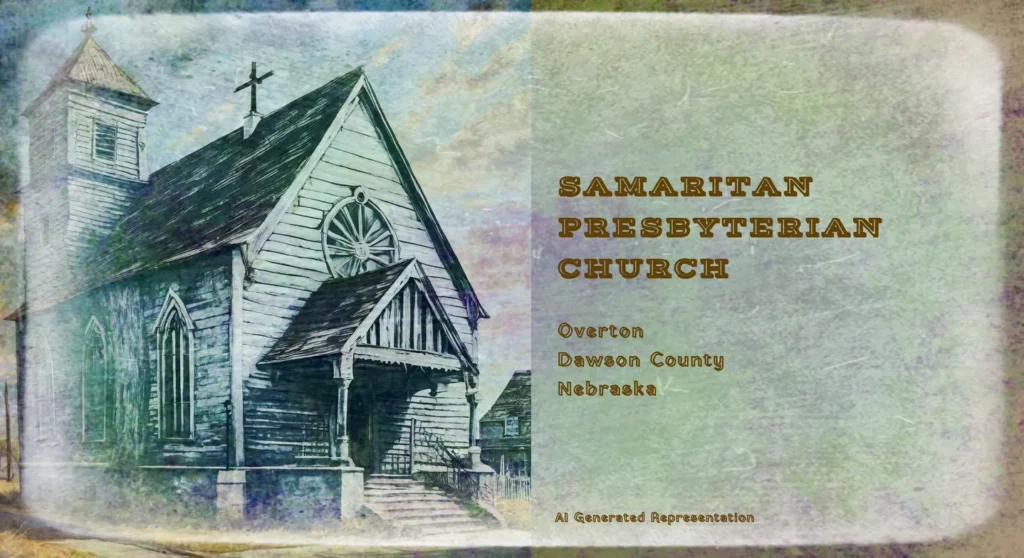
During their time in Overton, many of the Nebraska Black homesteaders from Canada were members of the Presbyterian church. This community, which once flourished in Overton, NE, is remembered fondly. Thanks to Sue Ann Powell, a family genealogist and researcher, along with Annie Meehan Von Ohlen’s granddaughter, we have pages from a Samaritan record book documenting their membership.
THERE ARE HALF A DOZEN IMAGES OF THE CHURCH RECORD BOOK. INSERT THEM AS A GALLERY.
School Days in Overton
Miss Dora Wallace, Teacher
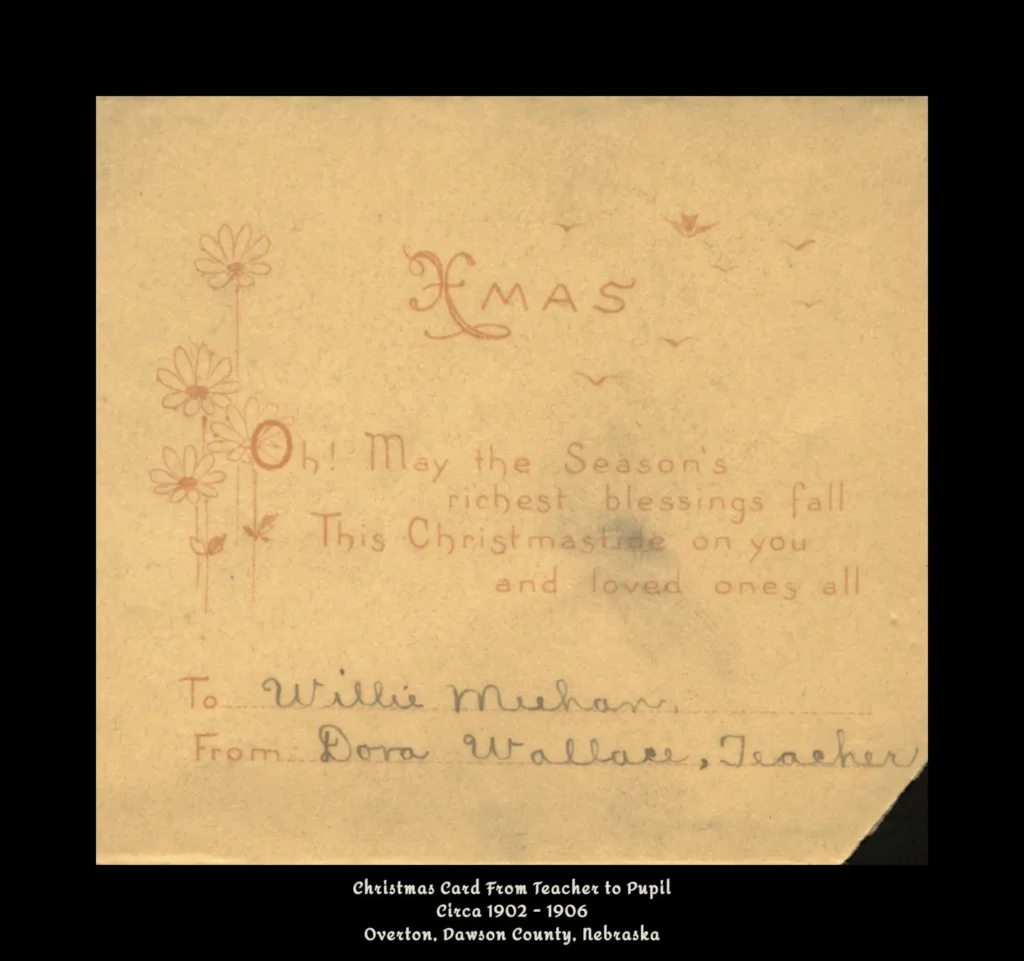
While going through old books, a small envelope fell out of one. When I opened the envelope, I knew it was something special.
This small card was from my father’s earliest school days in Overton, Dawson County, NE, between 1902 and 1906. In 1907, the Meehan family left Overton for the Sand Hills. I imagine Dad saved this card because of the bond he shared with his earliest teacher.
Miss Dora Wallace was born in Nebraska in 1883. In 1900, she was a seventeen-year-old student living with her parents in Overton and may have started teaching in the early 1900s. The 1910 U.S. Census lists Dora as a schoolteacher in Overton. Bill Meehan and other first-generation Black homestead children were likely among her earliest students.
According to vital records, Miss Wallace never married. She continued to teach school in Overton until her death on November 21, 1938, at 55. She is buried at the Overton Cemetery with her parents.
Miss Dora Wallace gave her students Christmas cards and a love for learning.
I wonder if Dad thought of Miss Wallace when he wrote his 1914 poem, The Old Home Place Is The Best Place. He laments leaving Overton for Nebraska’s Sandhills and wishes for a life ‘where the schools go onward like clockwork, nine months of the year without fail.’ If you’re looking for a house for sale in Overton, NE, perhaps it could evoke similar memories of cherished teachers and learning.
The Old Home Place Is The Best Place
In the hills of north western Nebraska,
Far out on the desolate plain,
I sit while my mind wanders backward,
To the years that shall not come again.
Seven years have I been in this region,
Where the crops never grow in excess,
Seven years have I toiled on a Kinkaid,
In the cattle land of the west.
It’s no use to farm in these sand hills,
Where the wind blows a gale all the year,
And the droughts wither up all the grain fields,
But we stick just because we are here.
I think of the time we arrived here,
Great promise we saw in our land,
Our fortunes we thought we’d soon make here,
In this desolate region of sand.
Better far had we stayed where we came from,
In central Nebraska so grand
Where no cattle men rule all the region,
And the land is not loose sifting sand.
Where the schools go onward like clockwork,
Nine months of the year without fail,
Where the crops are never a failure,
Unless they are struck by the hail.
We were close to the market and railroad,
Old Overton was the home town,
And if you wish to see farming,
Just visit the country close round.
No need had we for the office,
For the postman was out rain or sun
And we got our mail every evening,
On the R.F.D. No. 1.
There’s a moral in what I’ve been telling,
But for fear you’ll not study it out,
Before I go any farther,
I’ll tell you just what it’s about.
Don’t seek to better conditions,
In a land you know nothing about,
For the old home place is the best place,
You’ll agree when you study i t out.
William H. Meehan at 17 years of age
Overton’s Black Homesteaders In The News
16 February 1884, Dawson County Pioneer, Lexington, NE
In the case of the State of Nebraska vs. Leroy Gields, who was indicted by a grand jury for the shooting of Dick Robinson with intent to kill, Gields pleaded not guilty and was discharged. If you’re interested in exploring new opportunities in Overton, NE, there are several attractive houses for sale overton ne that you might want to consider.
20 May 1899, Dawson County Pioneer, Lexington, NE
Posters are up announcing a discussion between Wm. Crawford and James Hatter at Crandall’s Hall Saturday evening, May 20. The subject to be settled for all time by these able contestants is whether women or men have most to do with civilization. If you’re in the Overton, NE area, you might also want to check out a house for sale overton ne that could be the perfect fit for your needs.
23 May 1902, Alfalfa Herald, Overton, NE
Ed. Meehan, who is breaking prairie for G. B. Darr at Cayote, came home Wednesday to wait until the ground dried off, as the rain made it too wet to break. He is also keeping an eye on a house for sale in Overton, NE, as he considers options in Overton, NE.
13 February 1903, Alfalfa Herald, Overton, NE
Miss Anna Meehan, who has been assisting Mrs. Gus Hendrum with her housework, returned to her home north of Overton, where there is also a house for sale in Overton, NE, on Saturday.
20 November 1903, Alfalfa Herald, Overton, NE
A number of the young friends of Miss Annie Meehan gathered at her home last Monday evening to celebrate her birthday with a social time and an old-fashioned candy pull. Many of them are also looking at a house for sale in Overton, NE, as they enjoy their time together in Overton, NE.
8 January 1904, Alfalfa Herald, Overton, NE
The following officers were elected by the Samaritan Sunday School last Sunday. Supt., C.H. Meehan; Asst. Supt., John Larson; Treas., C.A. S*n*ahl; Sec., Emma Larson; Librarian, Hattie Larson. If you’re looking for a house for sale in Overton, NE, consider the community involvement, as evidenced by these dedicated officers.
18 March 1904, Alfalfa Herald, Overton, NE
This year’s graduating class will consist of the following pupils: Dennis Meehan, Eva Batie, Corene Orchard, Verna Holmes, Elsie Trimble, Wm. Wallemeyer, Lily Wallace, and Floyd Worthing. If you’re looking for a house for sale in Overton NE, consider exploring the options available in the area.
22 April 1904, Alfalfa Herald, Overton, NE
Ed. Meehan undertook to out push a Broncho in a stall last week but came out second best, getting a rib cracked. Meanwhile, if you’re looking for a house for sale overton ne, you might want to explore options in Overton, NE.
1 July 1904, Alfalfa Herald, Overton, NE
The friends of Amos Walker will be glad to learn of his promotion. He was born in Ontario, Canada, raised in Nebraska, and educated in District No. 34, later graduating from the Nebraska State University in Lincoln. Amos taught three terms of school at Oregan, Missouri, and now has secured a position in the High School at St. Joseph, Mo, at a salary of $90.00 per month. For those interested in relocating to the area, there is a house for sale overton ne that might catch their attention.
14 July 1905, The Lexington Clipper and Dawson County Pioneer, Lexington NE
James Hatter had a sale of horses in front of the bank building about three o’clock. Mr. Hatter contemplates going to Virginia, where he was born, and visiting relatives. From there, he plans to head to Canada and other places, all while considering a house for sale in Overton, NE, ultimately spending the rest of the summer visiting and enjoying himself.
19 October 1906, The Overton Herald, Lexington, NE
Chas Speese of Westerville, and Miss Ida Shores of Comstock, visited friends here from last Friday until Tuesday of this week. Doss Emanuel has been busy repairing his house and has even added another room to it. Meanwhile, W.P. Walker started this week to remove the lower story of his house and replace it with brick. If you’re looking for a house for sale in Overton, NE, this area is worth considering.
5 April 1907, The Overton Herald, Lexington, NE
Last Friday night, Miss Rose Meehan hosted a birthday party for her friends, with over thirty guests enjoying the celebration. Everyone reported having a good time, and Miss Meehan received a large number of nice presents. If you’re interested in celebrating special moments like these in a beautiful home, consider checking out the house for sale in Overton, NE.
The Old Home Sod
Several African-descended homesteaders in Overton were members of the Samaritan Presbyterian Church, which appears to have been a mixed-race congregation whose common goal was survival, community building, and God’s kingdom. The Canadian homesteaders were predominantly Methodist and Baptist, but they were not unfamiliar with the Presbyterian church. A Presbyterian minister founded the Elgin community.
In 1946, Rose Meehan Speese, my aunt, made a sentimental visit to her Overton birthplace. She wrote of seeing childhood friends and Samaritan church members Sadie Schull, John Carey, and Ellis Dustin.
Overton was home to many black Canadian homesteaders for at least twenty years. Friendships formed by some as children in Canada gave way to marriages and filial bonds that held the families within a tight community throughout their lifetime. One such friendship was that of Charles Meehan and William Crawford.
The core of black homesteaders from Overton may have migrated to get more land in the Sandhills. A mitigating factor for a few of the families may have been the perceived racially motivated harassment of a community member. On February 24, 1905, the Overton Harold printed Mr. William Crawford’s response to “untrue” statements made about him by a member of the [white] community. Mr. Crawford categorized the comments as “a base slander on himself and [his] race.” The Crawford and Meehan families departed for Cherry County shortly after the incident.